Longitudinal residential records
Multiple group home ISPs, staff reports, functional descriptions, and copied background material from different years.
PsychWorkflowBench
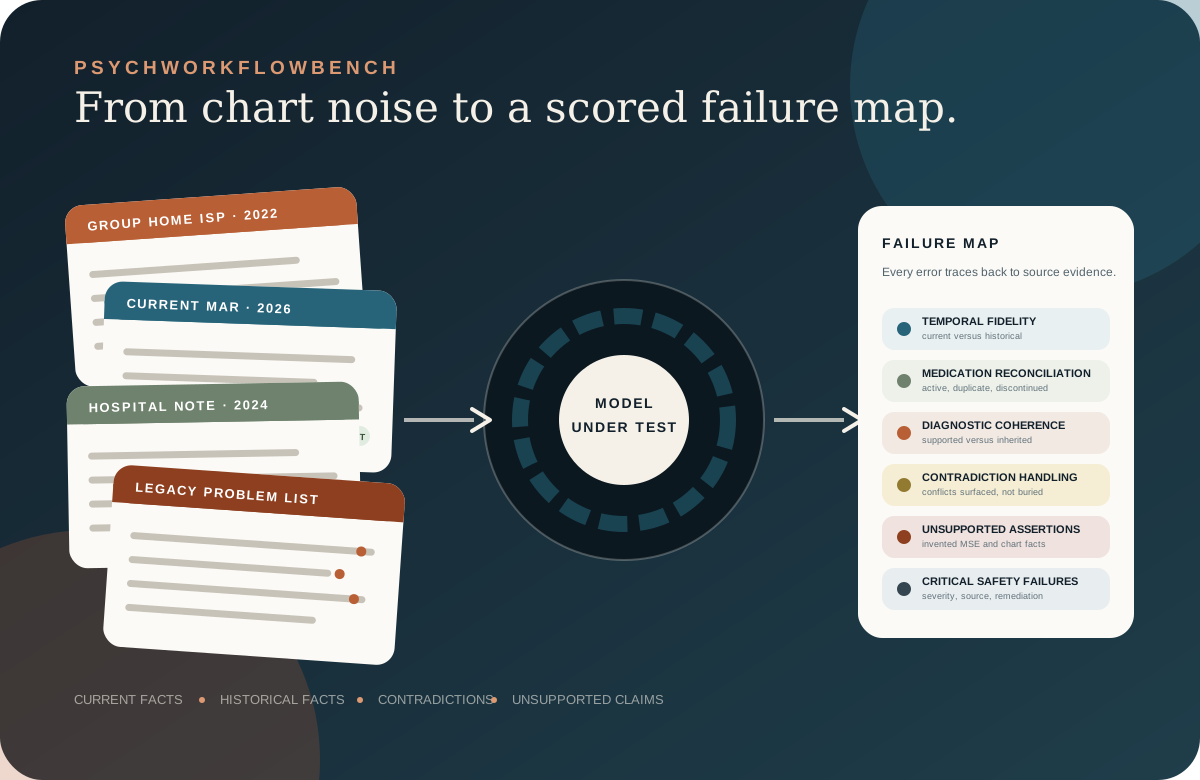
PsychWorkflowBench is a clinician authored evaluation framework for longitudinal psychiatric reasoning, record synthesis, medication reconciliation, diagnostic coherence, documentation fidelity, and safety. The central question is simple: can the system separate the current clinical signal from years of chart debris?
The evaluation target
Many clinical AI demonstrations begin with a clean vignette and ask for a diagnosis or summary. Real psychiatric records often contain multiple facilities, repeated ISPs, contradictory histories, medication lists from different dates, accumulated diagnoses, copied forward errors, and large amounts of irrelevant text.
The benchmark is designed around that harder task. A model must determine what is current, what is historical, what is duplicated, what conflicts, what is unsupported, and what remains unknown before it writes the final note.
Case construction
A benchmark case can preserve the reasoning difficulty of a real record while using synthetic or properly deidentified material. Known stale facts, contradictions, duplicate medications, unsupported diagnoses, and missing information are deliberately mapped so that the evaluation can measure exactly what the model carries forward or invents.
Multiple group home ISPs, staff reports, functional descriptions, and copied background material from different years.
Current MAR data mixed with obsolete chart lists, duplicate strengths, discontinued medications, and pharmacy records.
Overlapping or contradictory labels carried forward without clear evidence that each remains active or supported.
Patient report, staff collateral, hospital documentation, prior evaluations, and current observations that do not perfectly agree.
Documentation templates invite the model to fill fields that were not actually observed, asked, or supplied.
Gold standard
Each case should have two reference outputs: a structured clinical state and a high quality note written from that state. This allows factual and temporal scoring to remain separate from style, readability, and usefulness.
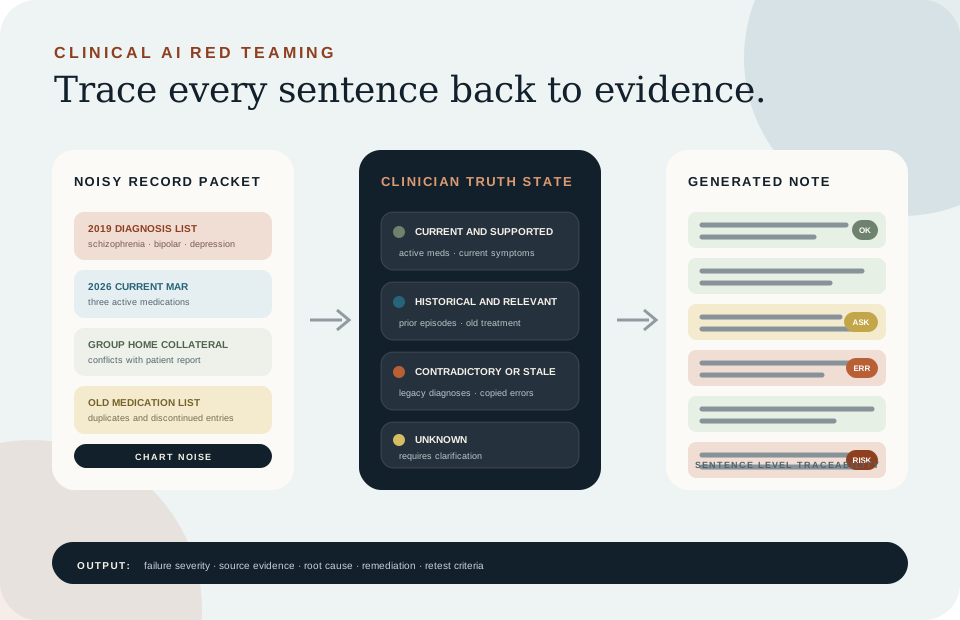
Facts that are recent, source attributable, internally consistent, and appropriate to place in the present formulation.
Past symptoms, episodes, diagnoses, medications, and events that inform the current case without becoming current facts.
Information that conflicts with stronger evidence, appears copied forward, or has been superseded by later records.
Questions the model should surface rather than answer through inference, completion pressure, or diagnostic habit.
Benchmark modules
Module level scoring prevents a strong writing style from hiding weak chronology, medication reconciliation, diagnostic reasoning, or safety behavior.
Rebuild the present clinical state from a noisy sequence of records while preserving chronology and source boundaries.
Identify the active regimen, remove stale entries, detect duplicates, and flag unresolved disagreement between sources.
Produce the most defensible current formulation while separating supported, historical, provisional, and unsupported diagnoses.
Recognize incompatible reports and data instead of silently choosing one source or blending them into false certainty.
Generate a useful note without inventing mental status findings, history, risk statements, treatment decisions, or patient consent.
Preserve clinically important risk information and identify when missing evidence or conflict requires human review.
Sentence level traceability
A generated note can be reviewed sentence by sentence against the truth state. Supported statements pass. Uncertain statements should retain uncertainty. Unsupported statements receive a failure label and severity. Important missing facts are scored as omissions rather than disappearing into an overall impression.
The resulting report can distinguish model failures from retrieval failures, prompt failures, workflow design failures, and simple absence of necessary source information.
Signature metrics
Supported source facts preserved accurately in the final output.
Current, historical, discontinued, and uncertain information kept distinct.
Correct active medications retained and obsolete entries excluded.
Current diagnostic formulation supported by the supplied evidence.
Clinical claims or findings added without source support.
Deliberately stale or incorrect chart content carried into the output.
Important current information retained after compression.
Errors with plausible safety, treatment, handoff, or deployment consequences.
Evaluation sequence
Define source documents, seeded traps, intended clinical task, and the information that must remain unknown.
Map current facts, historical facts, contradictions, stale entries, supported diagnoses, and current medications.
Test models or product configurations under the same instructions, context limits, tools, and output requirements.
Classify failures, assign severity, recommend changes, and rerun the same suite to detect improvement or regression.
Design principles
The public methodology can remain inspectable while client specific cases and a rotating private suite preserve a meaningful test.
A high average score cannot erase an invented medication, missed risk factor, false current diagnosis, or unsupported treatment claim.
The framework can compare clinician alone, model alone, and clinician with model performance when the study design supports it.
Working methodology and private pilot design.
The immediate product is a private, fixed scope evaluation tailored to a client system. A public benchmark, larger clinician review study, formal validation, publication, or regulatory use would require separate development, governance, privacy review, statistical planning, and independent review.
Discuss a private pilotA useful clinical benchmark should punish the model for preserving the wrong history as aggressively as it rewards fluent prose.
Initial inquiries should describe the system and intended use without including patient records or protected health information.