My argument
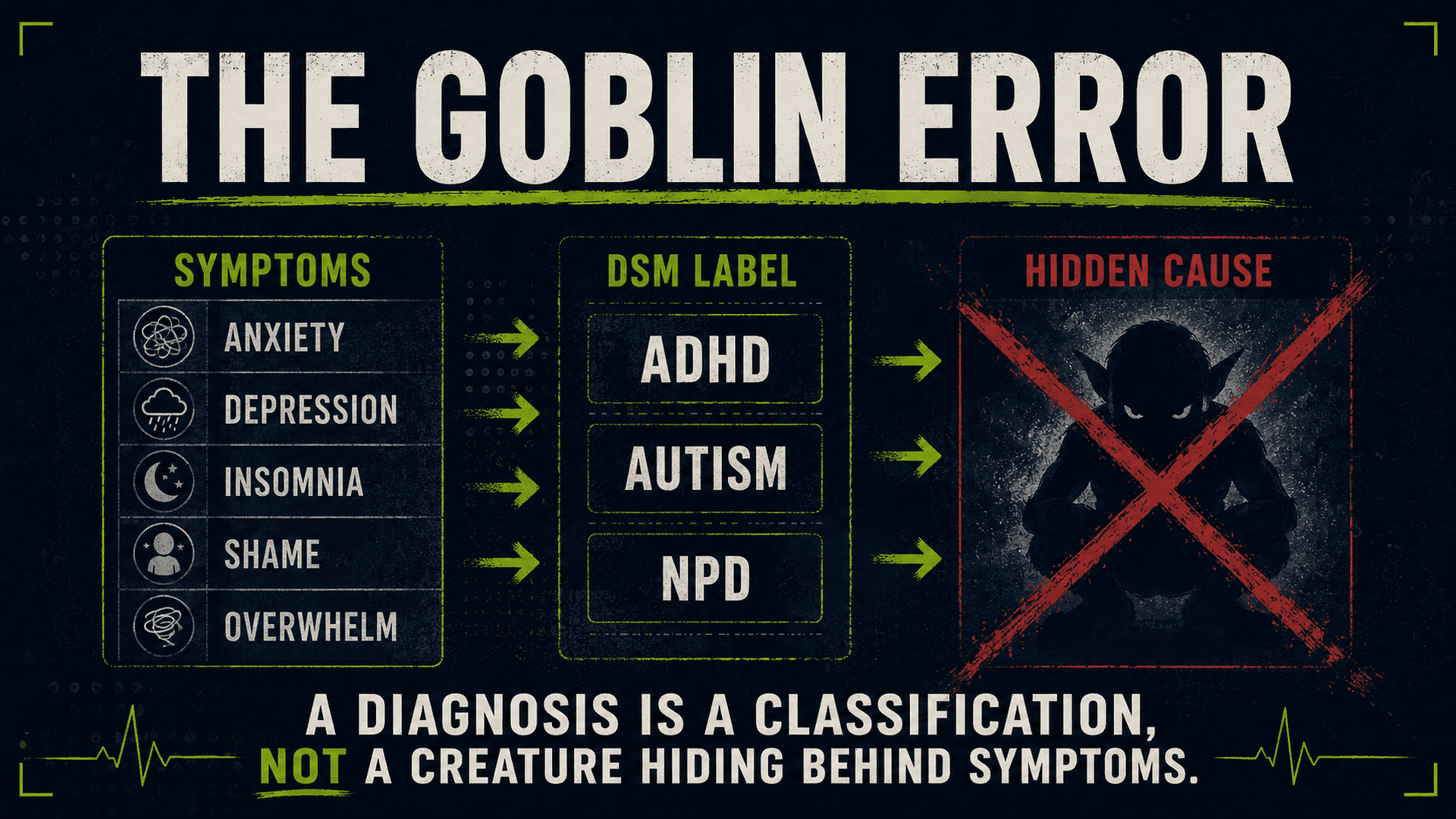
Psychiatry often mistakes a description for an explanation.
My claim is narrow. Many psychiatric diagnoses summarize what a person reports and what a clinician observes. The label is then used to explain those same observations.
That is where the theology comparison begins. A theology explains visible events through invisible forces, gives authority to interpreters, and supplies a moral vocabulary. Popular mental health language now often does this. A label can rewrite a biography. Therapy words can decide who is healed, unsafe, toxic, or disordered. Even disagreement can be treated as proof of pathology.
The key error
A diagnosis can be useful. It can organize information, guide care, support research, and unlock services. But usefulness is not causation. Many diagnoses are built from symptoms, duration, exclusions, and impairment. The label does not, by itself, identify what produced the pattern in this person.
The second arrow requires evidence that did not come from the label itself.
Sepsis shows the error. It is a syndrome, not a specific infection. Meeting sepsis criteria does not identify the organism or source. Diagnosing a particular bacterial infection from sepsis criteria alone would confuse the syndrome with its cause.
Yet the same reasoning appears when inattention helps establish ADHD and ADHD is then given as the reason for the inattention. The label may still be useful. It simply has not answered the causal question. Sleep loss, anxiety, depression, medication effects, substance use, medical illness, development, and environment still matter.
How the category grows
Research finds group differences. Public education turns them into traits. Social media turns them into diagnostic clues. Executive dysfunction, emotional dysregulation, and hyperfocus are legitimate subjects of study. A group association is not automatically a formal criterion, a unique feature, or a personal cause.
Poor concentration points to ADHD. Intense concentration becomes hyperfocus. Social difficulty points to autism. Social competence becomes masking. A theory that explains every possible observation no longer risks being wrong.
How the language gains authority
Trauma shows how a category can swell. PTSD Criterion A requires exposure to death, threatened death, serious injury, or sexual violence. SAMHSA uses a much broader public health definition: an event, series of events, or circumstances experienced as physically or emotionally harmful or life threatening, with lasting adverse effects.
The definitions are not equivalent. The SAMHSA definition does not require death, serious injury, sexual violence, catastrophe, or a comparable external event. Because emotional harm is defined through the person’s experience rather than an external event threshold, the eligible class can include any negative experience that is experienced as emotionally harmful and produces lasting adverse effects. The broad concept can then borrow the medical seriousness of PTSD even when the event would not qualify for PTSD.
Hidden pathology also sells. Courses promise to reveal masked autism, missed ADHD, narcissistic wounds, and abuse patterns that ordinary assessment supposedly overlooks. Some courses may be careful. The public sales pitch still rewards one answer: the real cause is hidden, and the trained interpreter can see it.
What better reasoning looks like
The answer is not to abolish diagnosis. It is to put the label back in its place. Start with symptoms, time course, context, impairment, development, sleep, medical factors, substances, medication effects, relationships, environment, and competing explanations. Ask what would make the favored explanation wrong. Use the label when it helps. Keep searching for the cause.